

About Iceland
What preceded
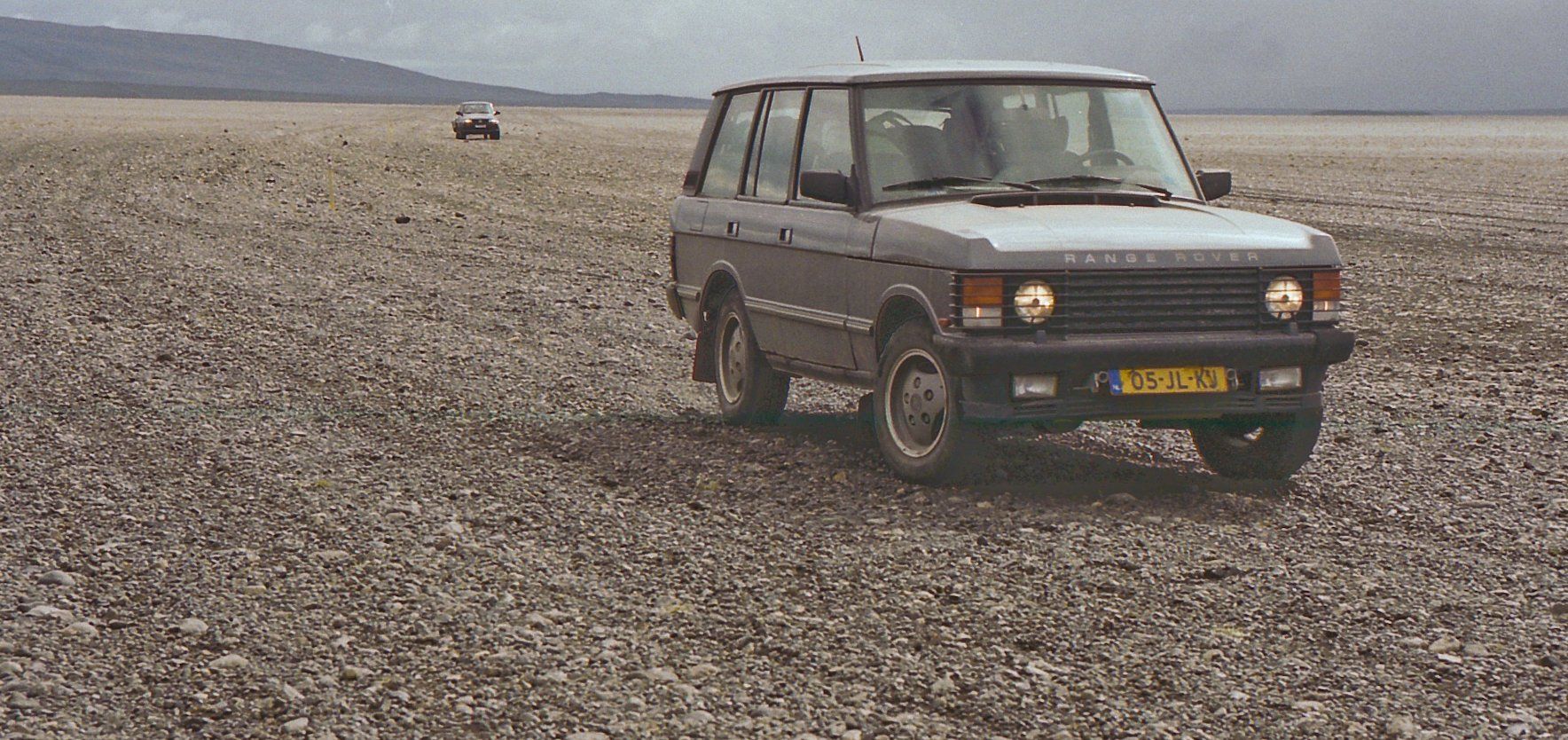
An impulsive decision led to a school friend and I spending our summer vacation in Iceland. We wanted to try something different from the usual holiday destinations in Europe. So we booked a plane ticket, a bus pass, and set off. We soon learned that taking the bus in Iceland means you need to have a clear plan. There is only one bus a day, and if you get off too early, you are stuck where you are and have to hope there is a place to sleep! Fortunately, that only happened to us once. We decided that we had to come back again. This country was so beautiful and we couldn't see enough of it from the bus; we had too little freedom to move around, we wanted to go straight through! We decided to save up for a next time. But times changed, we lost touch, he started a family, and things calmed down a bit. But my dream remained. In '93, I bought my first Land Rover. It absolutely had to be an 88 Series III, because that was the only real Land Rover, I thought at the time, and actually still do. Keeping a 1974 Land Rover 88 running cost a lot of money, leaving little left over to go on holiday far away. Lots of practice at club days and a fantastic 4x4 holiday with Kangeroe showed me the capabilities and limitations of the 88. I got a unique opportunity when I could buy a real Range Rover for a bargain price, and I traded the 'Series III', with a heavy heart, for the Range.
What a difference, what comfort, what power, and how expensive! Especially when it turned out the transfer case had seized up. “Fortunately,” there was a good alternative available, an even more beautiful Range Rover! After a year, however, the money really ran out, and it took a long time before I got around to a Land Rover again.
It is now 2002. I have saved up some money and am looking for a Range Rover. With previous experiences in mind, I fell for the comfort. During the week, I drive a modern lease car. Every weekend, however, I have to get used to the quirks of an old car all over again: bouncing over bad roads, swerving due to the indirect steering, and breaking a sweat when you just want to park.
Given those experiences and the expected poor roads in Iceland, it is certainly nice to be able to drive in a comfortable car. It turns out that luxury is not a luxury, but part of the preparation! Good road handling ensures relaxed driving, so you get out of the car feeling fit after a long drive. Later, it becomes apparent that even more luxury features contribute to a successful trip…
Preparing for the Iceland trip
Now that A had been said, B had to follow. I realized that a crossing alone is an expensive undertaking; besides, being alone is just that, alone. Sharing your experiences with others is, after all, an essential part of a journey. In my closest circle of acquaintances, I found no one who had the opportunity to join me. It was by now December 2002, and I wanted to make the trip in the summer of 2003. The thought occurred to me to look for travel companions myself. A maximum of four people, was my thought. The idea spontaneously sprang to set up a website containing information about Iceland along with a call for travel companions. That was a good idea. After a first timid attempt with a one-page site, I got the hang of it, and building the site evolved into a hobby in itself. I didn't forget the goal either, and soon responses with tips and questions started coming in. Time was running out, but nevertheless, by around May, I had three travel companions, my maximum. A trial weekend in the Ardennes and some conversations were the only things we knew about each other. Two of them had previously traveled through South America together for six months. If you can do that, you know what teamwork is.
The preparation
I had already started that at Christmas; through an informative visit to a Land Rover Specialist and some of my own ideas, I arrived at the following points:
Underbody protection, headlight protection, front and rear towing eyes, shock absorber replacement, general technical inspection, spare parts, and new towing tools. An appointment was made for the details, and everything would be carried out in April.
I read websites about Iceland online, but nowhere did I find a clear indication of how good or bad the roads are. It wasn't until the Iceland Tours trade fair in Utrecht that I spoke to someone who could tell me from personal experience what it's like there. He reassured me: good equipment is half the battle. And if you set out in a Land Rover, things can hardly go wrong…
The preparation of the car took a long time, far too long. Misfortune never comes alone, and bad luck followed me. It dragged on until a few days before the boat trip before the car was ready. Stress keeps you sharp, but I don't want to experience it this sharp again.
The crossing.
With Askja Travel, you can have your car shipped from Rotterdam by the shipping company Eimskip and fly after it yourself. That seems luxurious, but my considerations were: if you go along on the boat yourself, it takes at least two days of sailing, and another two days for the return trip. I am not in education, so my days are limited. Even if you go via Denmark or Sweden, it takes a long time; the kilometers you cover also cost time and money (the Range Rover gets about 6 miles per gallon anyway). Although a bit simple, the customs clearance and delivery were arranged quite nicely. There was even a nice printout ready for me, showing how to get back to Central Station from the port using public transport!
We had packed the car full of all the heavy stuff we wouldn't immediately need for the first night. Tents, hiking boots, provisions, etc. That saves us some weight on the plane later. Flying, I don't like it, but the flight was neat and well-organized. I had my GPS with me on the plane, which was nice. I could track exactly where we were flying, how fast and how high, and after I had entered the destination Reykjavik, I also knew how long it would take. You do have to sit by the window, but that goes without saying.
Finally Iceland
The arrival in Iceland is not pleasant; the international airport of Keflavik lies in a grey, bare, and unwelcoming setting. From there, a bus goes to Reykjavik, a journey of about 40 km through a dreary landscape. I keep insisting that the sun does shine sometimes and that there are much more beautiful areas than this surroundings.
The plan was that after arriving in Iceland, we had to spend a night without a car (so without a tent, etc.), and we did so at the local StayOkay (formerly a youth hostel). It was still quite nerve-wracking, despite the preparations: would the Range Rover have arrived, and in one piece? I couldn't contain my curiosity, and on our evening walk, we walked to the Eimskip terminal. It is located close to the StayOkay, so it was an ideal spot. Fortunately, the car was waiting there neatly behind the gate in good condition, ready to be picked up the next morning.
After a well-deserved night’s sleep at the comfortable StayOkay, we divided up the tasks. Two of us looked after the luggage while the other two went to collect the car. This caused a bit of a problem, as the booking had been made by someone other than the car’s owner. After some discussion, we got the papers and a neatly printed set of directions to the customs office. Once there—everything was within walking distance—we had the only official business of the whole trip: showing proof that we had the car documents, getting a temporary import permit and having the Green Card checked. Everything was handled very efficiently and courteously. Then, delighted with the car, we drove off to begin our adventure.
By road
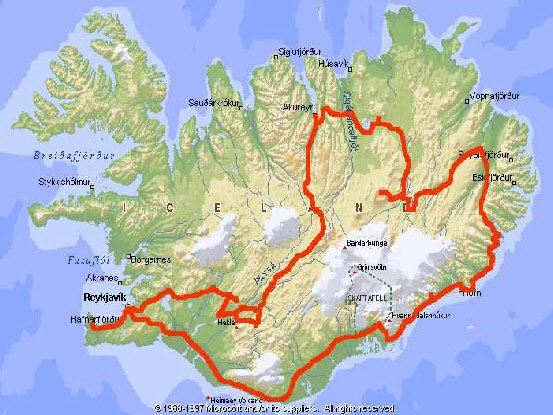
It had been agreed beforehand that we would follow a general route with (photo) stops wherever we wanted. The blueprint was to go via the famous Geysir and Gulfoss towards Hrauneyjar, then straight through the interior to Akureyri, subsequently eastwards to Mývatn and Krafla Seydisfjordur, follow the east coast, and then return to Reykjavik along the south coast. A total of approximately 1,500 to 2,000 km. We took it easy the first two days, only using the good roads and getting used to the traffic. There is hardly any, but that is precisely what makes it so treacherous. You have hardly any reference to other road users and therefore no idea whether you are driving fast or not. In some places, the road is even dangerous. There is no hard shoulder, and the road is built on a small dike, meaning that if you are not paying attention for a moment, you can easily end up off the road and, with a bit of bad luck, upside down as well.
By now acclimatized, we decide to take a shortcut marked on the map as unpaved. After driving around the Gullfoss waterfall, we find ourselves in the hinterland on a decent road that leads us into the mountains. Here we also encounter the first truly free-roaming sheep, and even a herd of cows on our path. Horse riders appear out of nowhere, and along the way we stop frequently to enjoy the view and take photos. Gradually the terrain becomes rougher and the road worse, until it finally just disappears.
Thanks to good map reading and the GPS, we get back on the route and continue on our way. We have been driving for over an hour without a sign of life until we suddenly come across two hikers, whom we cheerfully wave hello to. Better them than us, because there isn't much shelter and the weather is getting worse. The road is probably only intended for the maintenance of the electricity pylons running alongside it. We don't encounter anyone else.
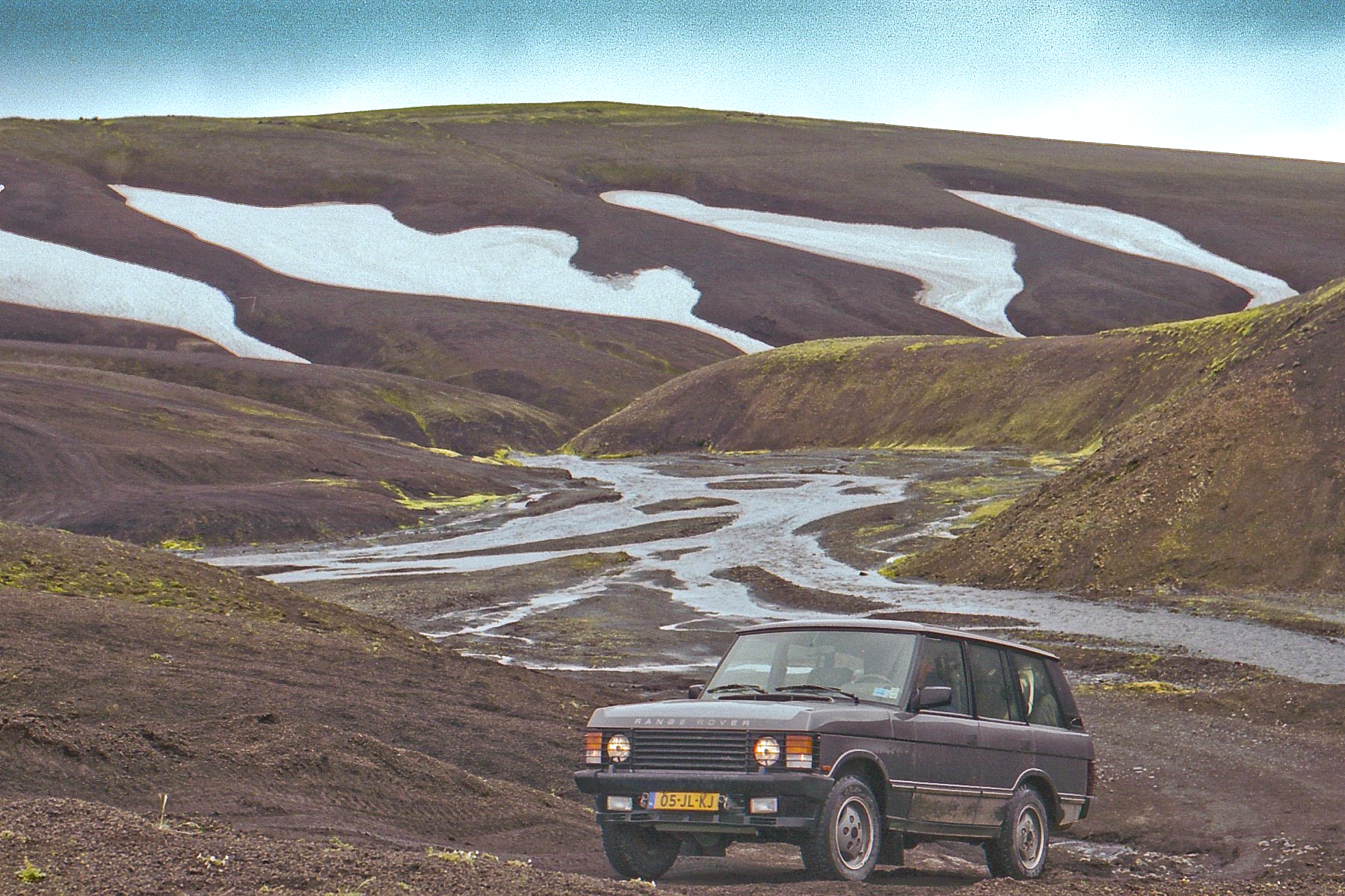
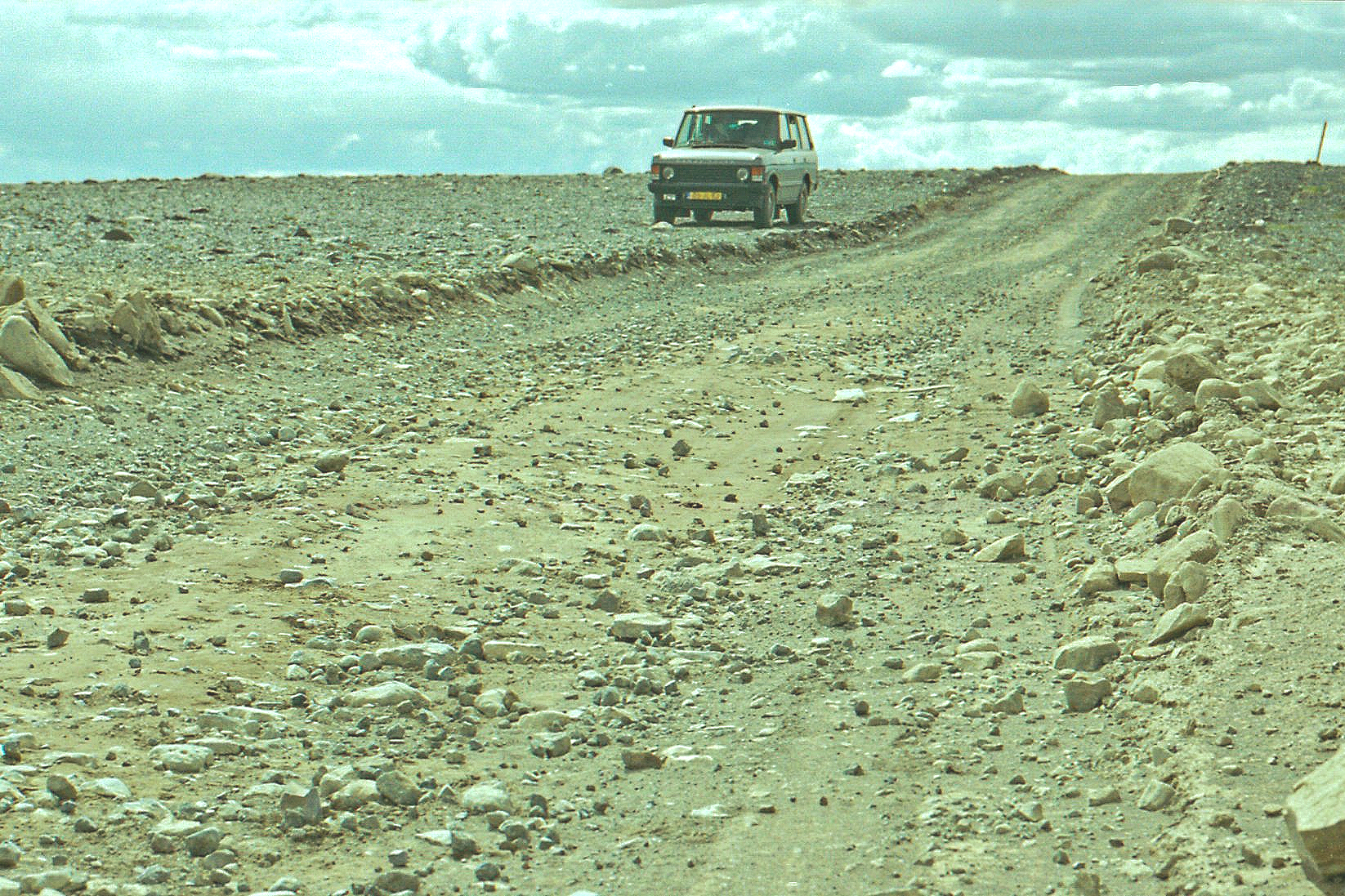
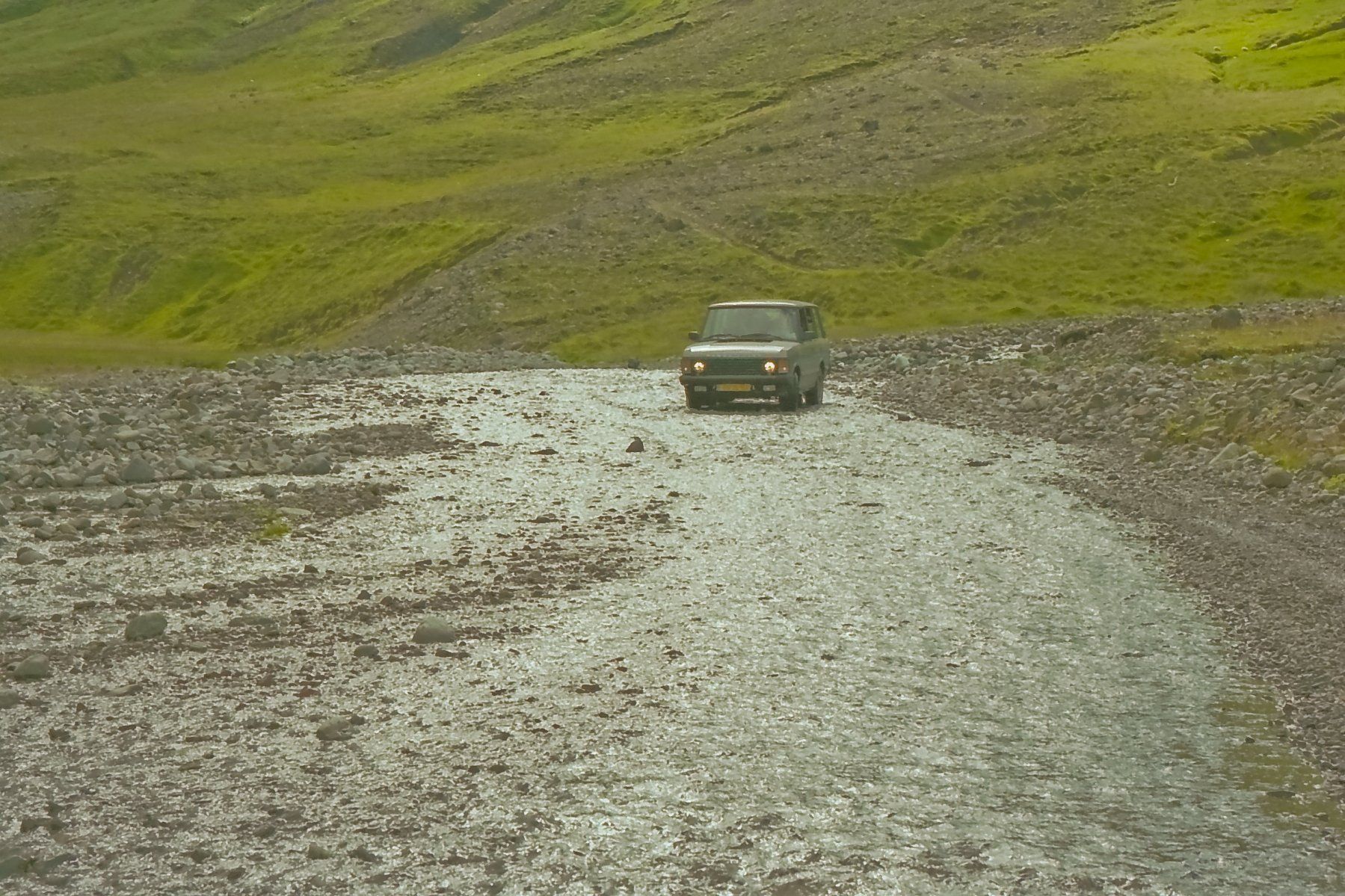
What was meant as a warm-up turns out to be quite a tough ride after all. The road gets progressively worse, and in second gear we crawl over large boulders and through deep potholes, eventually arriving at our first crossing. A sign warns that you can cross here, but that it is not a given that where the tracks run is also the best spot…. After some deliberation, Evert decides to take stock, rolls up his trousers, and goes to explore the river barefoot in his flip-flops, armed with a sounding rod. The water turns out not to rise much higher than knee height, so we decide to wade across with some trepidation. A sense of victory washes over us as we proudly make it to the other side. A second and a third crossing soon follow. The third one was tricky; the bottom protection proved to be anything but a luxury, and the feeling that a 2-ton car is floating is certainly nerve-wracking. Moreover, when you reach the other side and have to climb a steep slope—which you find daunting during an LRCH club day—now really has to be tackled in practice. The trip we had planned for a few hours has already lasted well over four hours, and we are almost there when we have to cross another river. Evert leads the way again, and now it is not only getting very deep, but the water is flowing fast, and potholes and boulders turn out to be hidden at crucial spots. We don't dare attempt it. We cannot count on help from others; this road is probably rarely used, and certainly not tonight. It is already past eight. Consulting the GPS and map, we conclude that we would be better off turning back and reaching civilization via a turnoff we apparently overlooked. The bad weather does not invite an overnight stay in the tents. The road turns out to be very poor; we are making slow progress. Large boulders and potholes hinder a reasonable pace. We have had enough of driving at a snail's pace and are getting hungry. It is already after 11:00 PM, and even on the long day in Iceland, it is getting darker now, and we are going to need the lights. I am so glad I bought the steering guard; it makes driving a lot more reassuring, especially when you occasionally hear a tap against the metal. Just when we had given up hope of ever reaching civilization, we found a mountain hut. Equipped with water, beds, and basic cooking utensils. More than welcome. So, at midnight, we prepared a well-deserved meal and went straight to bed.
The next morning, the world looks completely different again: beautiful surroundings and a babbling brook. Absolute silence and a watery sun. Life isn't so bad after all! We left the cabin in good order (washed up, swept clean, and windows properly locked). We traveled on with renewed spirits and were soon among people again. We stocked up for the really rugged trek. After all, we want to cut straight through to Akureyri. In the Netherlands, we had already stocked up on cans of tuna, powdered milk, rice, noodles, and pasta products. Also handy was the purchase of two boxes that function like drawers, allowing them to be stacked, which proved very practical. As soon as you drive out of the small villages, the road deteriorates. The asphalt ends and is replaced by compacted gravel. It is passable in itself, but I think that is also because we are driving a comfortable car and, not to forget, the ample ground clearance. We did our final shopping at Hrauneyjar. This is a dreary motel with a gas station. Although another gas station was marked on the map, we were told that this was the last station until Akureyri! That later turned out to be correct. So, the tank was filled to the brim and the two spare jerrycans were filled as well. One hundred liters at 1:6, enough for the round trip. After all, we had no idea whether consumption might increase due to rough terrain or if we would take the wrong route, just like before. Better safe than sorry!
Straight through Iceland
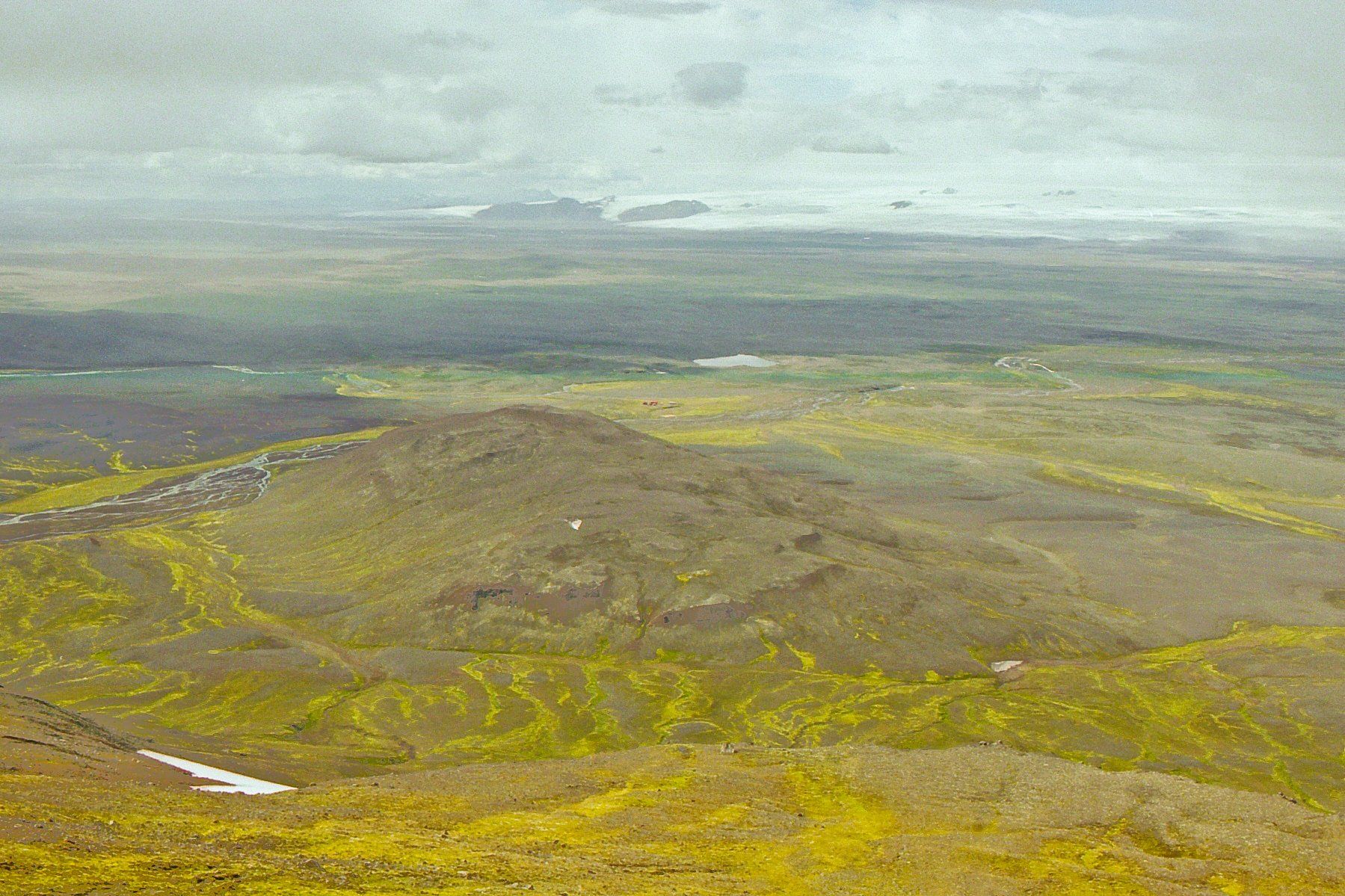
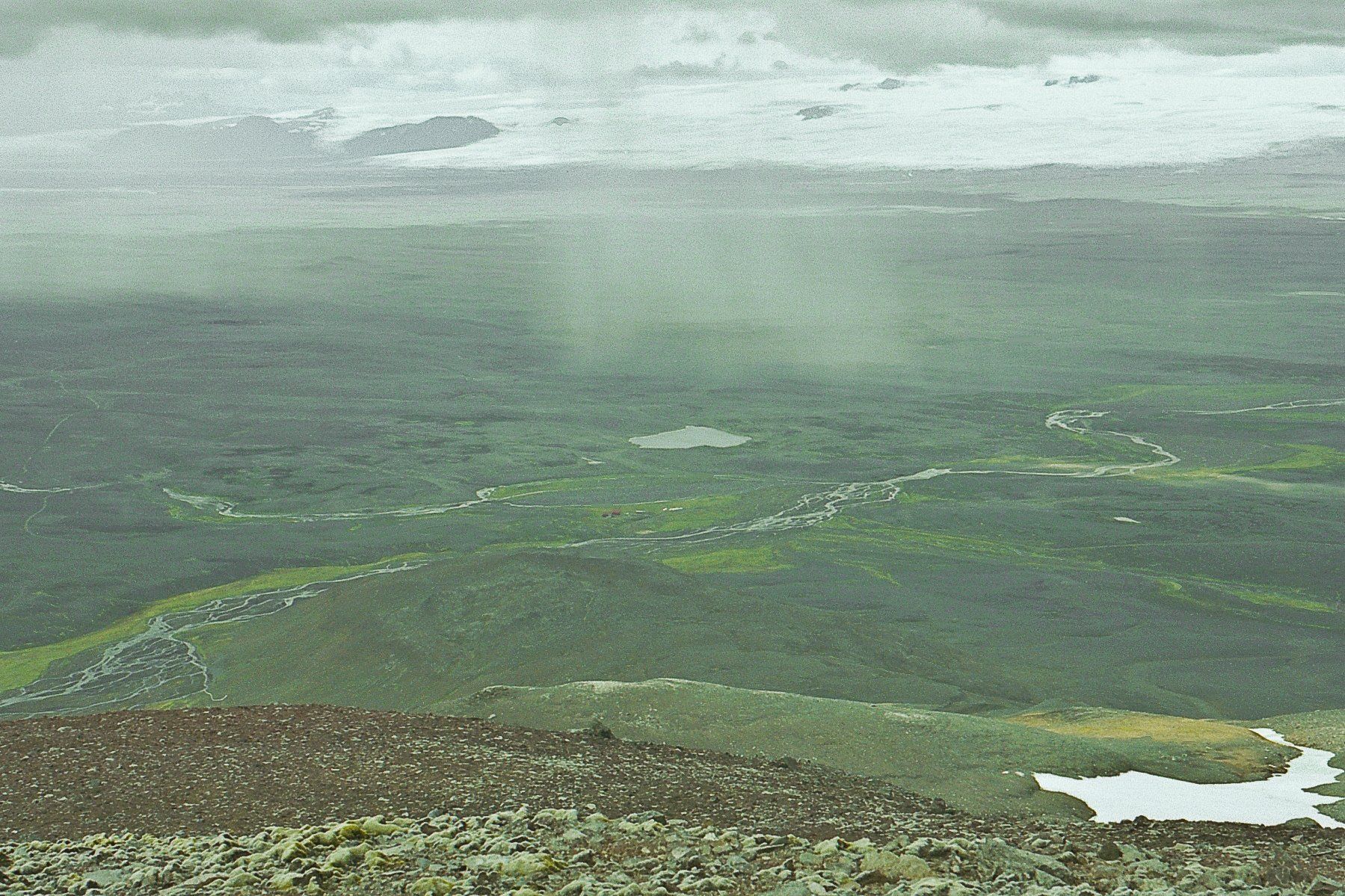
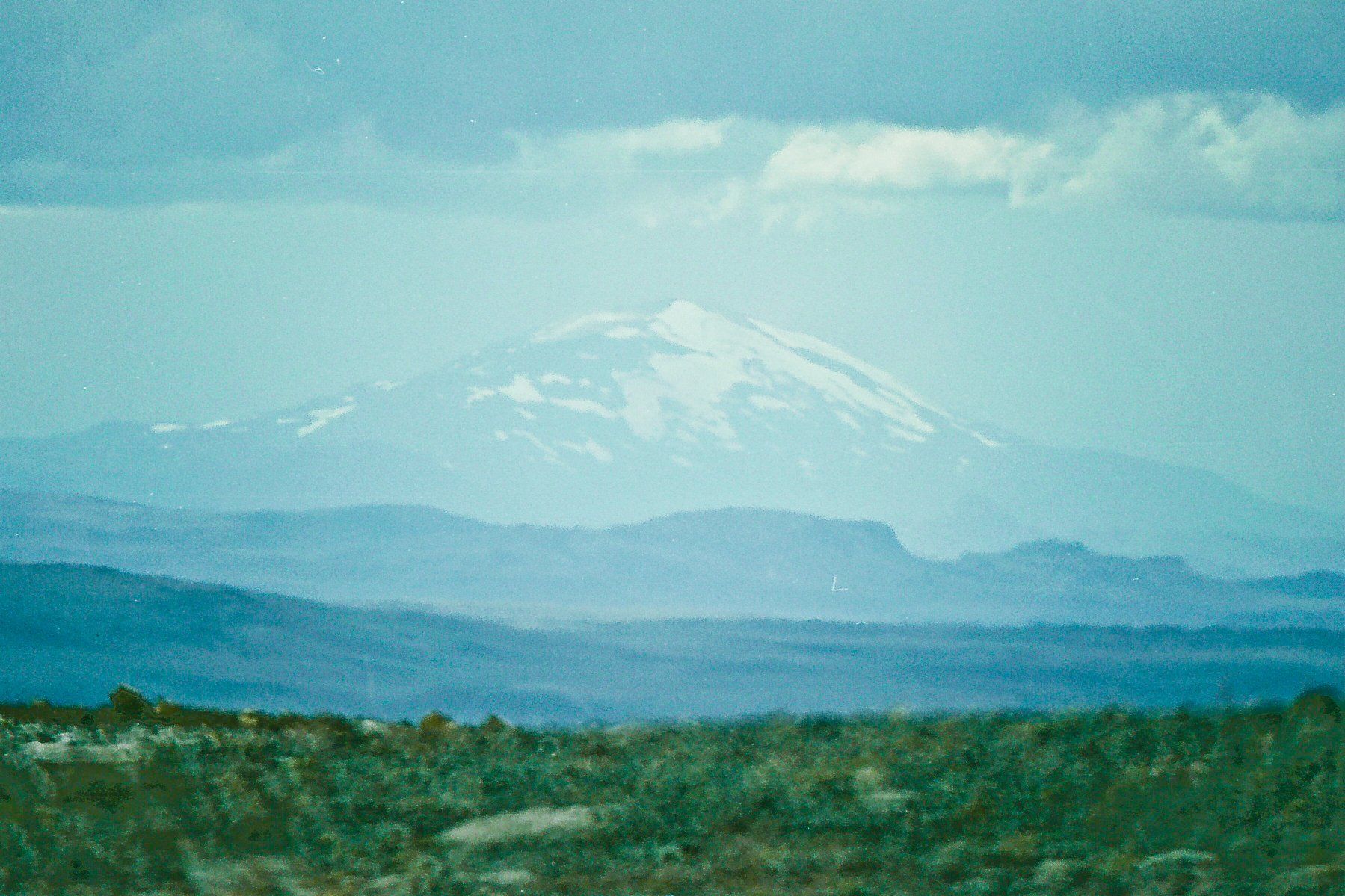
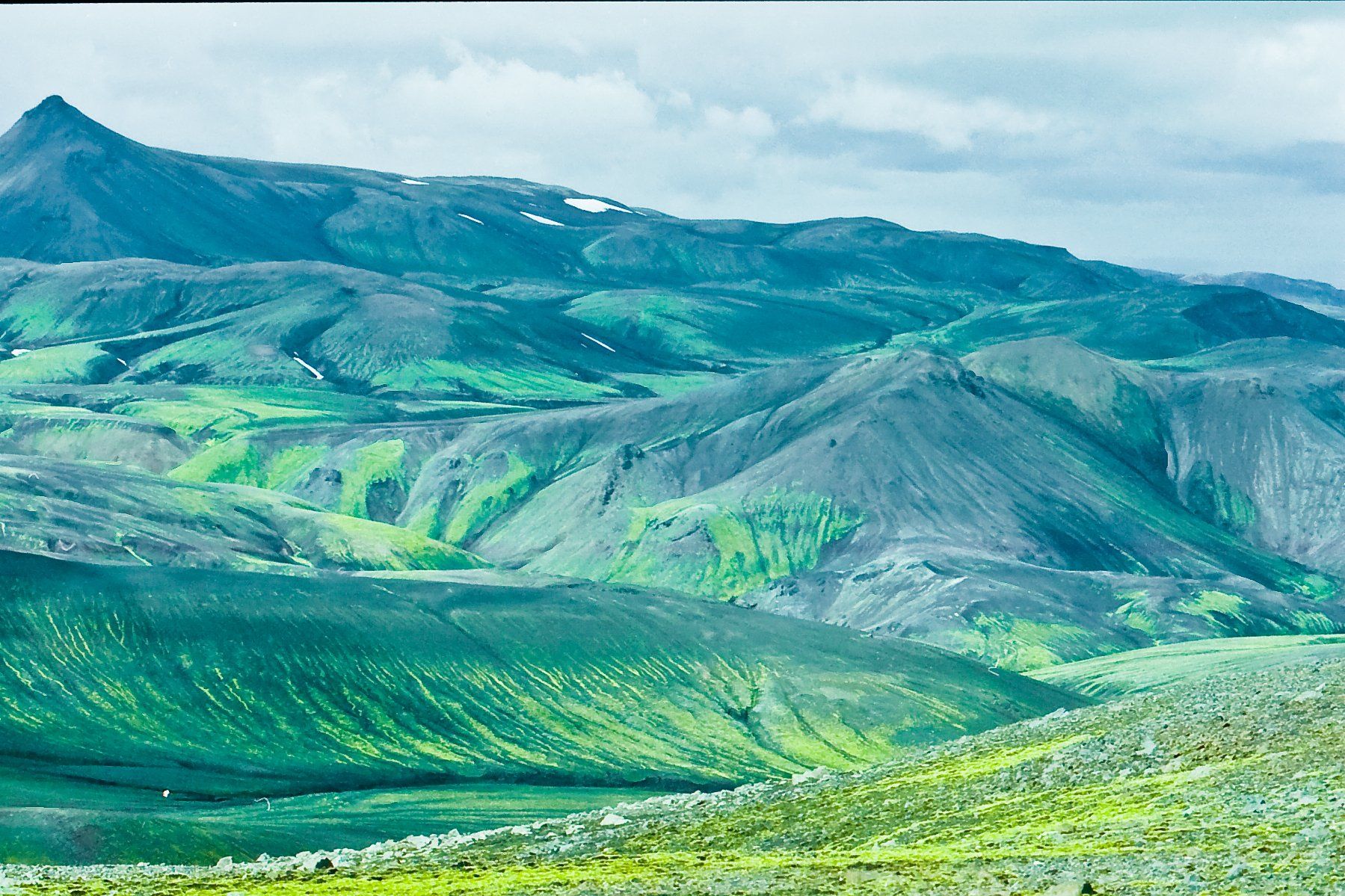
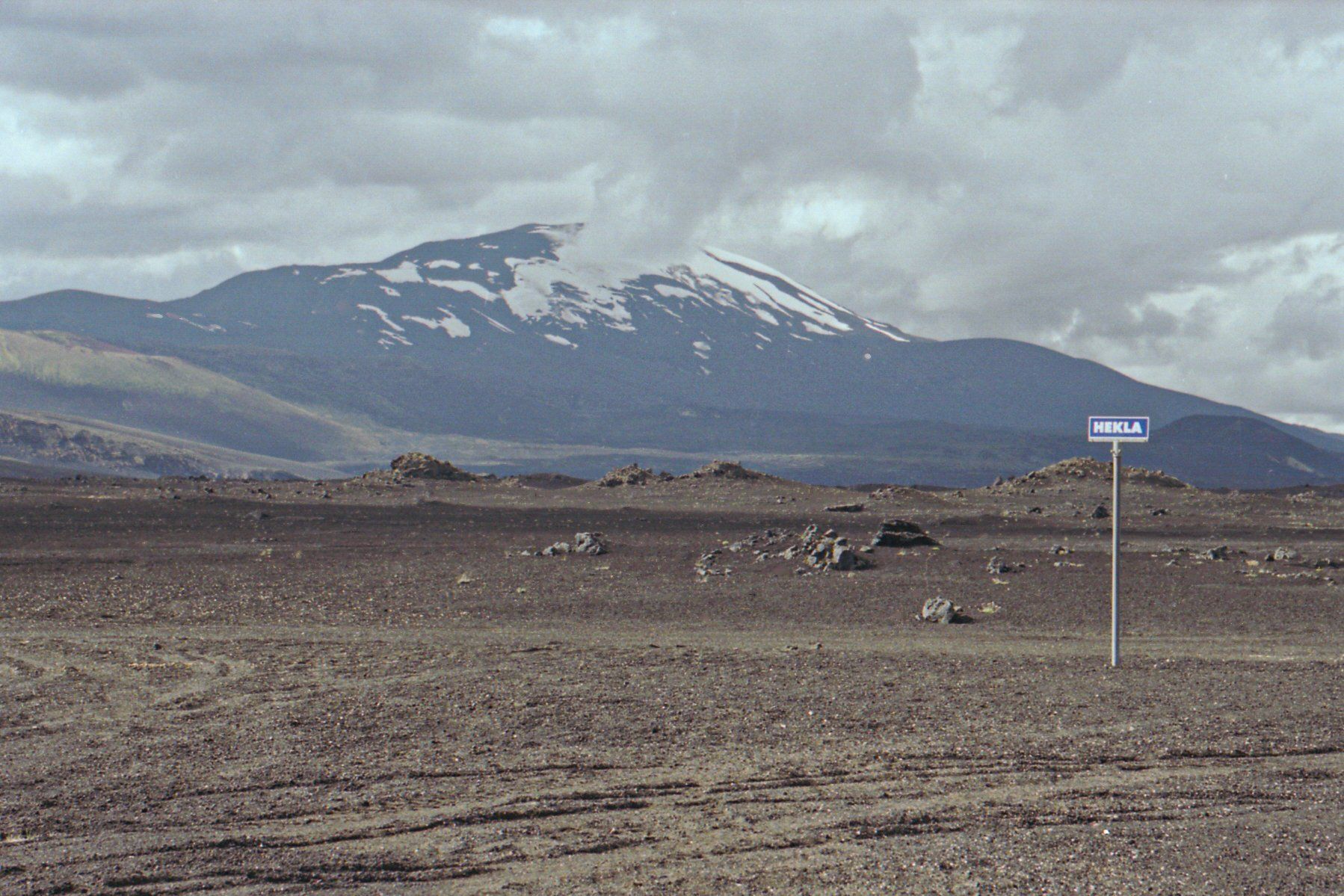
The road soon turns bad. We are driving on a sort of washboard road, shaking almost to pieces. The trick is to find the right balance between progress and vibration. Meanwhile, we see an ever-changing landscape. From green slopes to grey plains, glaciers on the horizon, rain showers in the distance that take on a magical quality due to the low-lying sun. The previously mentioned luxury turns out to be simply practical: we frequently get into the car wet, which is not conducive to fabric upholstery; fortunately, the leather upholstery is easy to clean, and the air conditioning is also doing its best to keep the windows free from fogging up. Around us, we see vast plains, glaciers on the horizon, the Vatnajökull, Hofsjökull, and the Myrdalsjökull. The weather is good, and unlike in our country, it is not hazy, allowing us to see incredibly far. This invites us to take photos and peer through the binoculars. This is why I wanted to go straight through; there is more than just the ring road! Fun fact: the motorcycles you encounter are German, the cyclists are Dutch, and the walkers are often Americans. If you come across a Land Rover, it is almost always a Dutch person, so always wave! I mainly feel sorry for the cyclist. Cycling along an endlessly bad road, encountering a small river, getting off, taking luggage to the other side, going back through the water, cycling through the water, putting the luggage back on, and then discovering two hundred meters further on that there is another river, and history repeats itself…
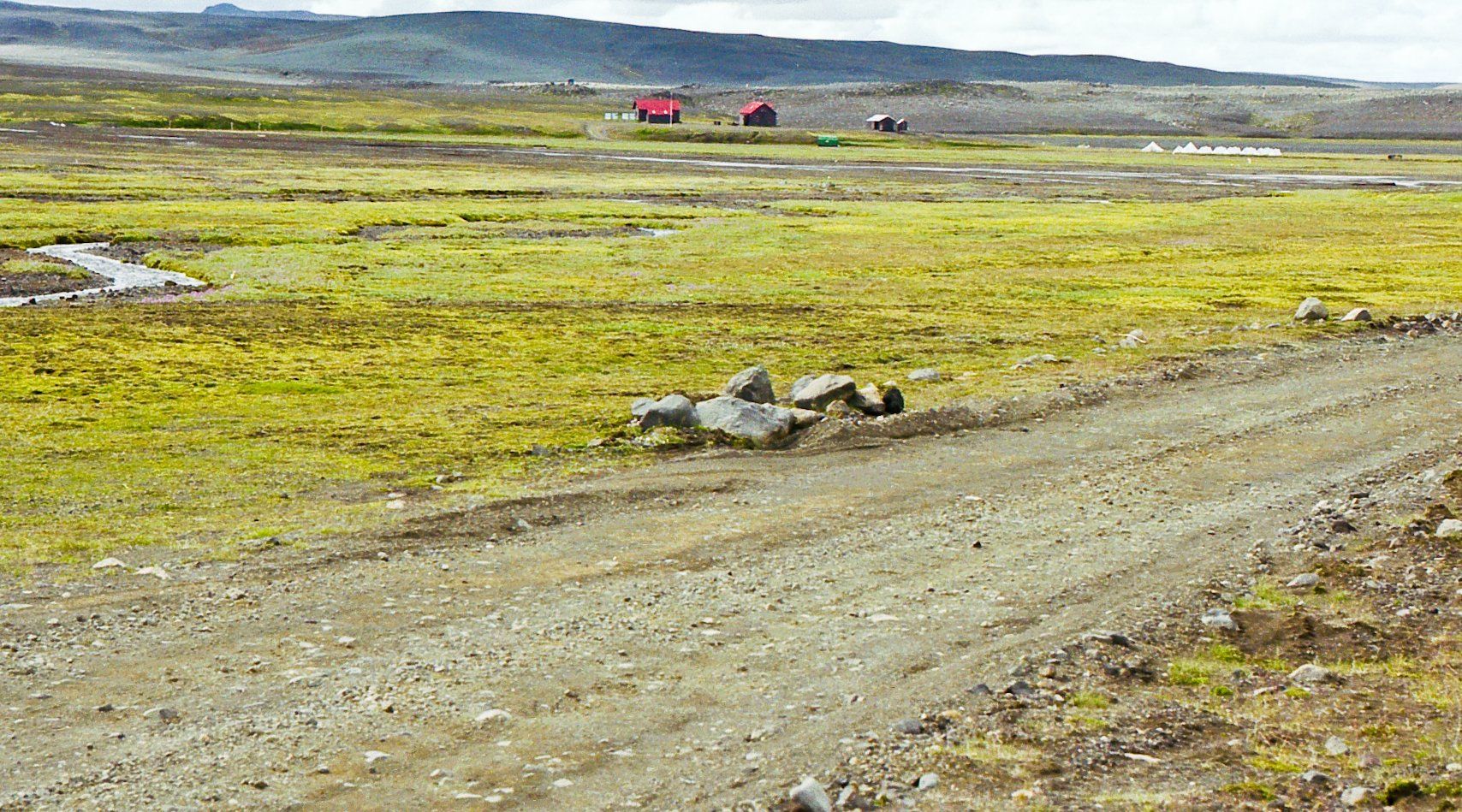
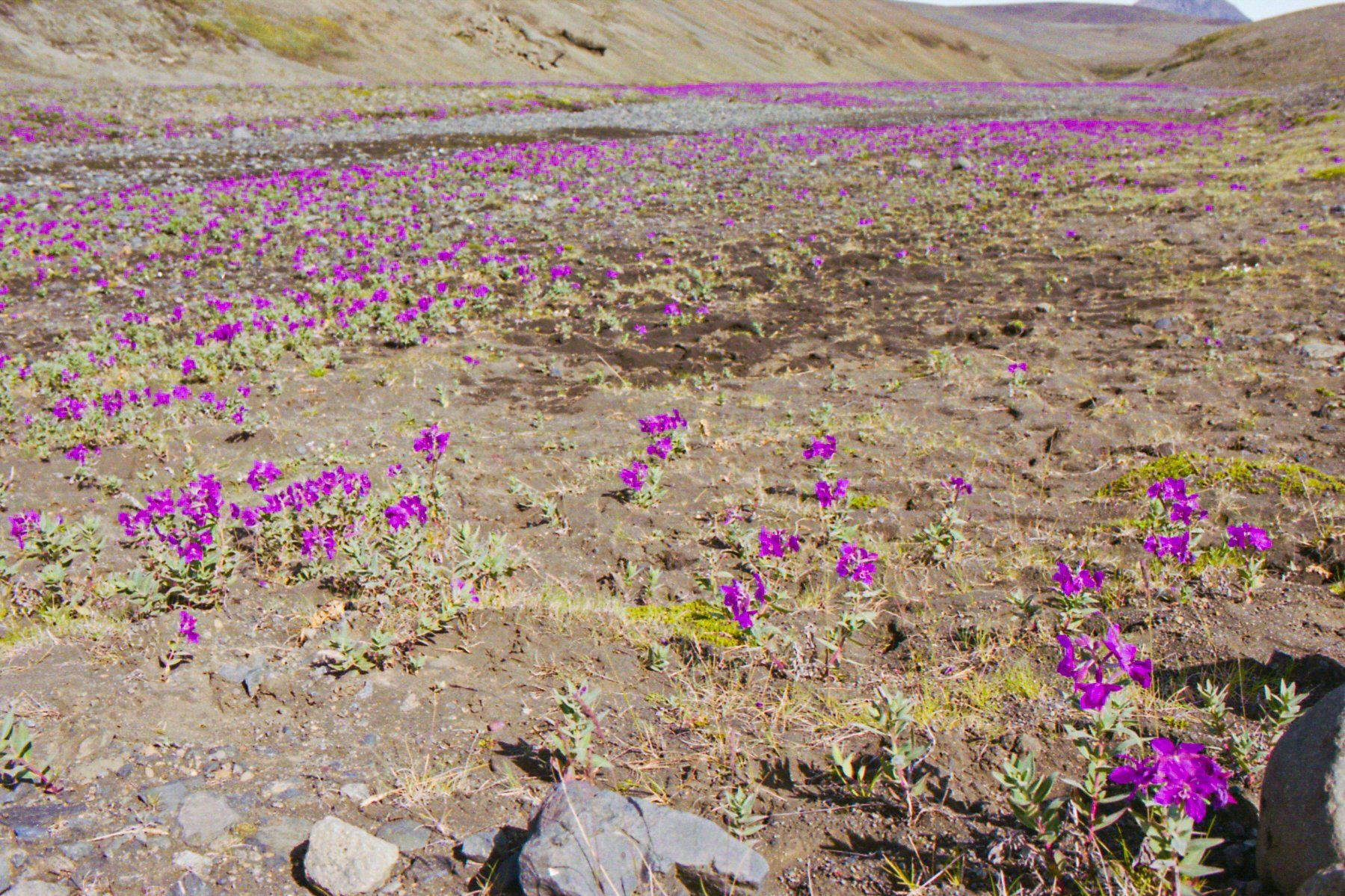
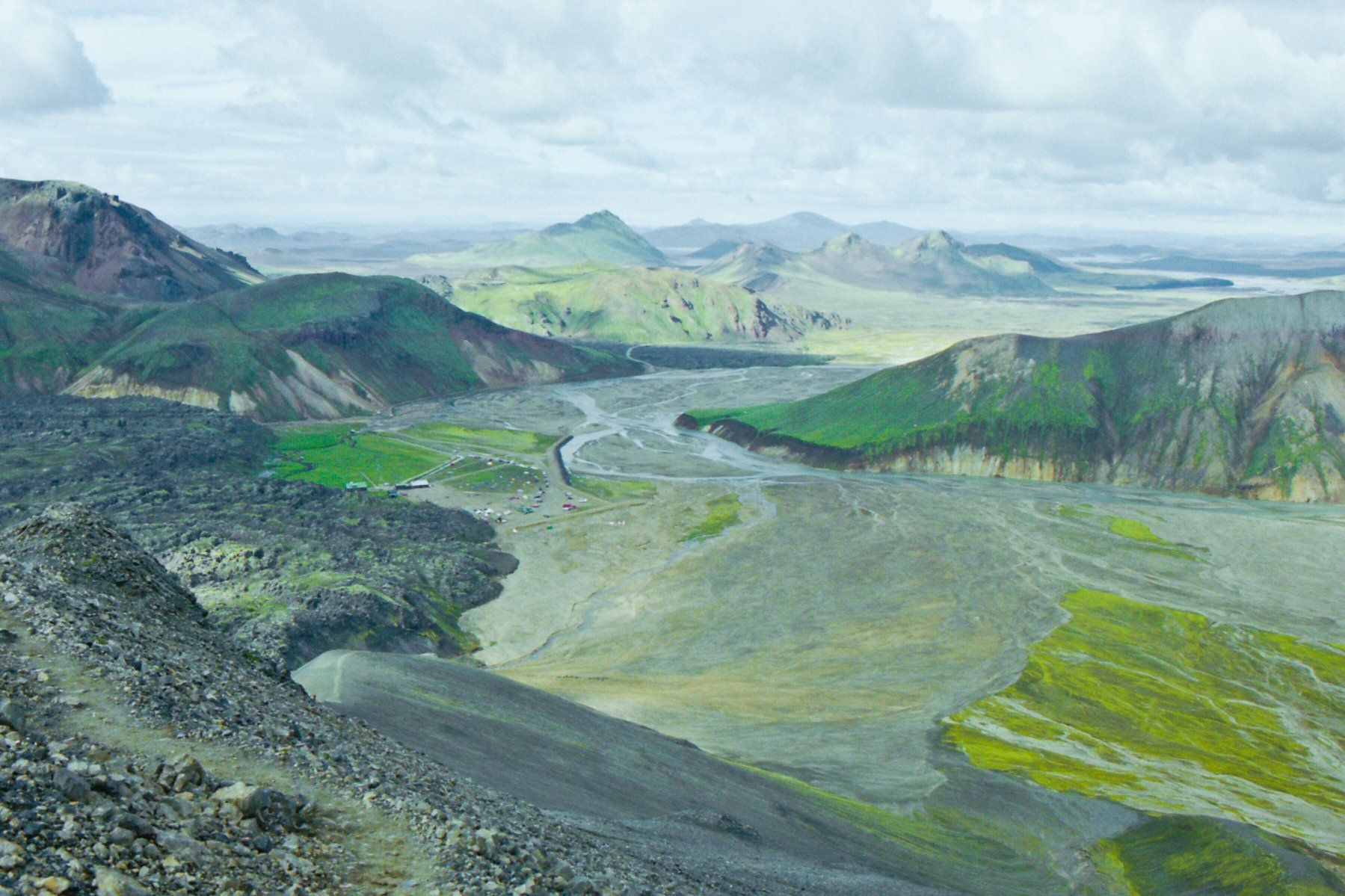
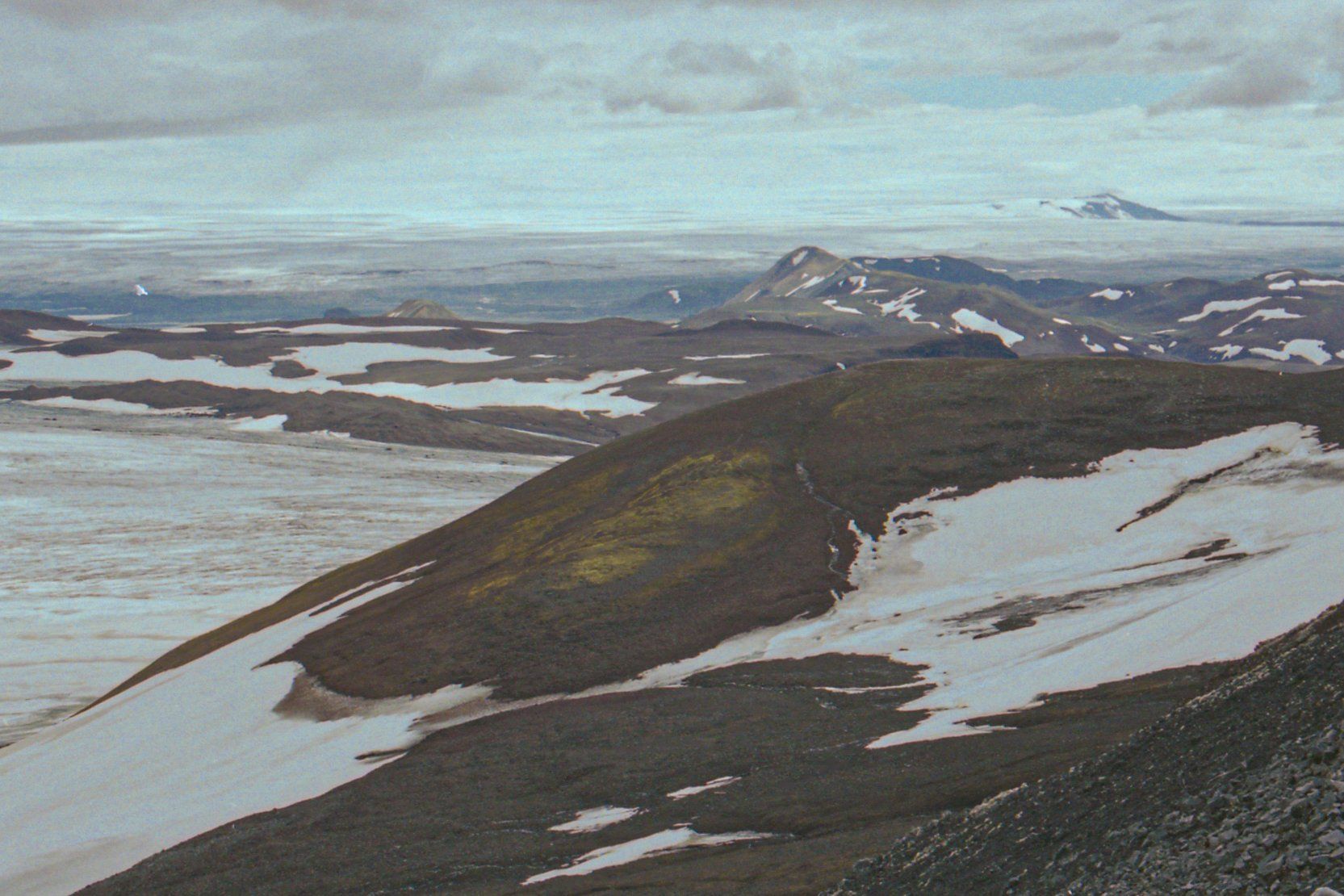
The beauty of the interior is that the banks of the small rivers display a beautiful purple due to a small plant whose name I do not know. I have been told that it is an imported plant that thrives better than expected in this rugged climate. And suddenly the moment arrives: from Hrauneyjar, after about 110 km, we reach the Nýidalur campsite. The hut appears out of nowhere after the last bend in the road, surprisingly charming with red roofs and the Icelandic flag in front of the door. We decide to stay here for two days and take a hike up Mount Hahyma to see the glacier lying behind it. After a day of driving, the trek is a strenuous undertaking; we climb from about 700m to the summit at 1400m! Battered by wind and rain along the way. Once at the top, we have a good view of the surrounding landscape. It is truly worth the effort; there isn't really a path, just posts indicating the direction. It demands a lot from your sense of balance. Good hiking boots are a must, as the route leads not only through thick layers of slippery moss but also through rolling lava rock and large boulders.
After a good night's rest, having packed up all our belongings, checked tire pressure and oil level, we set off towards Akureyri via a slightly different route that looks a bit more challenging on the map. The start is gloomy; the rain is pouring down, the temperature is around 8°C—it is the height of summer! The road is in poor condition, with deep puddles of brown mud every few hundred meters—which, incidentally, we navigate with great amusement without slowing down. We now turn onto the F752. A good choice; the landscape is more varied, and we really feel like we are on the road in the right car. More or less gradually, the landscape becomes less rugged, the temperature rises, and we find ourselves in the valley leading to Akureyri. Water flows in large quantities like countless waterfalls across the road, and entire sections of the road are underwater. The view that was expansive recently is now obscured by green slopes on both sides. The temperature rises as well, and the sun breaks through. The GPS indicates that we have descended from about 800m to around 60 meters. We enter a paradisiacal valley, with meadows containing cows, birds, flies, and mosquitoes. We hadn't seen so much life in a long time.
Akureyri, we are halfway there.
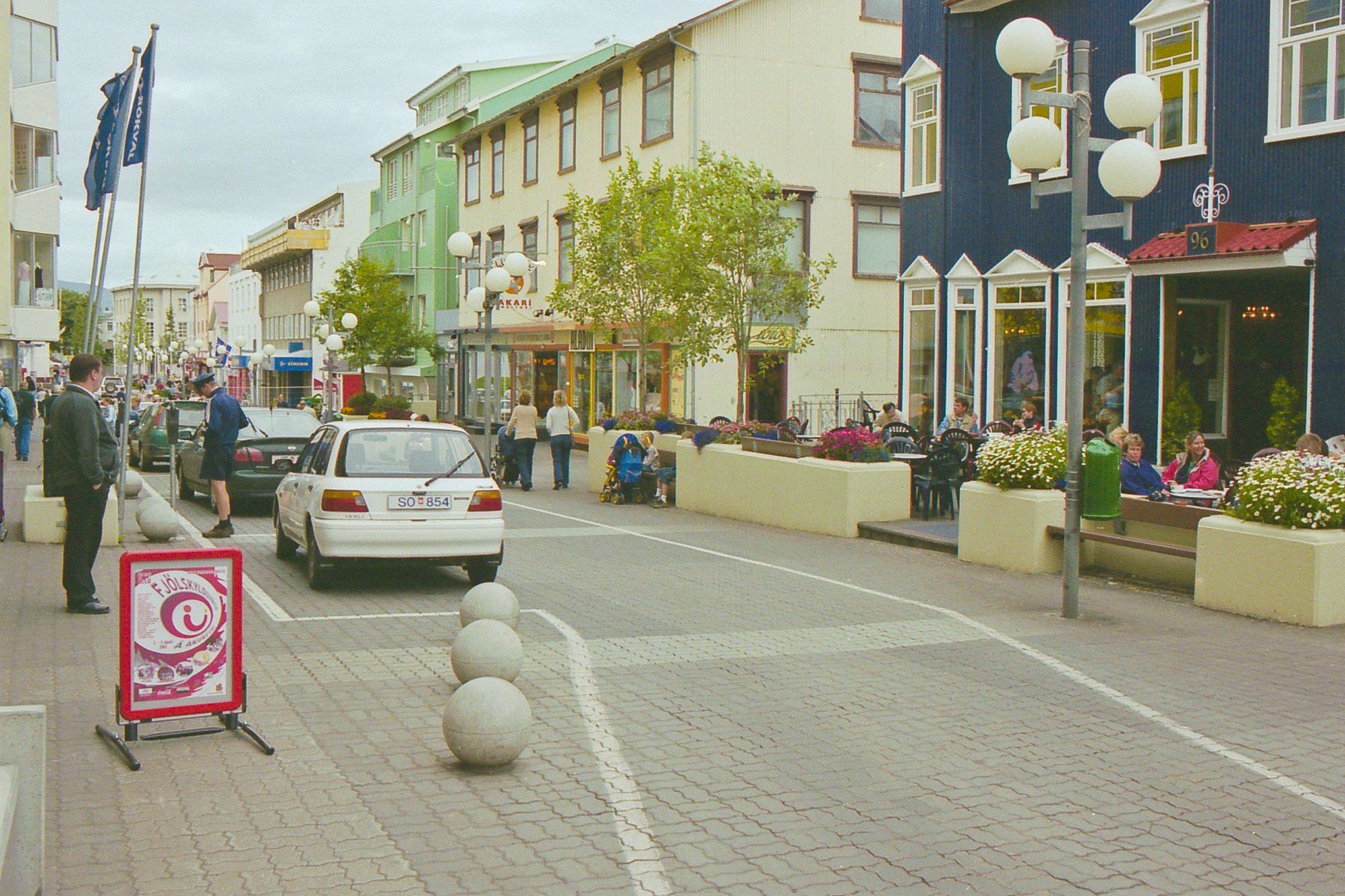
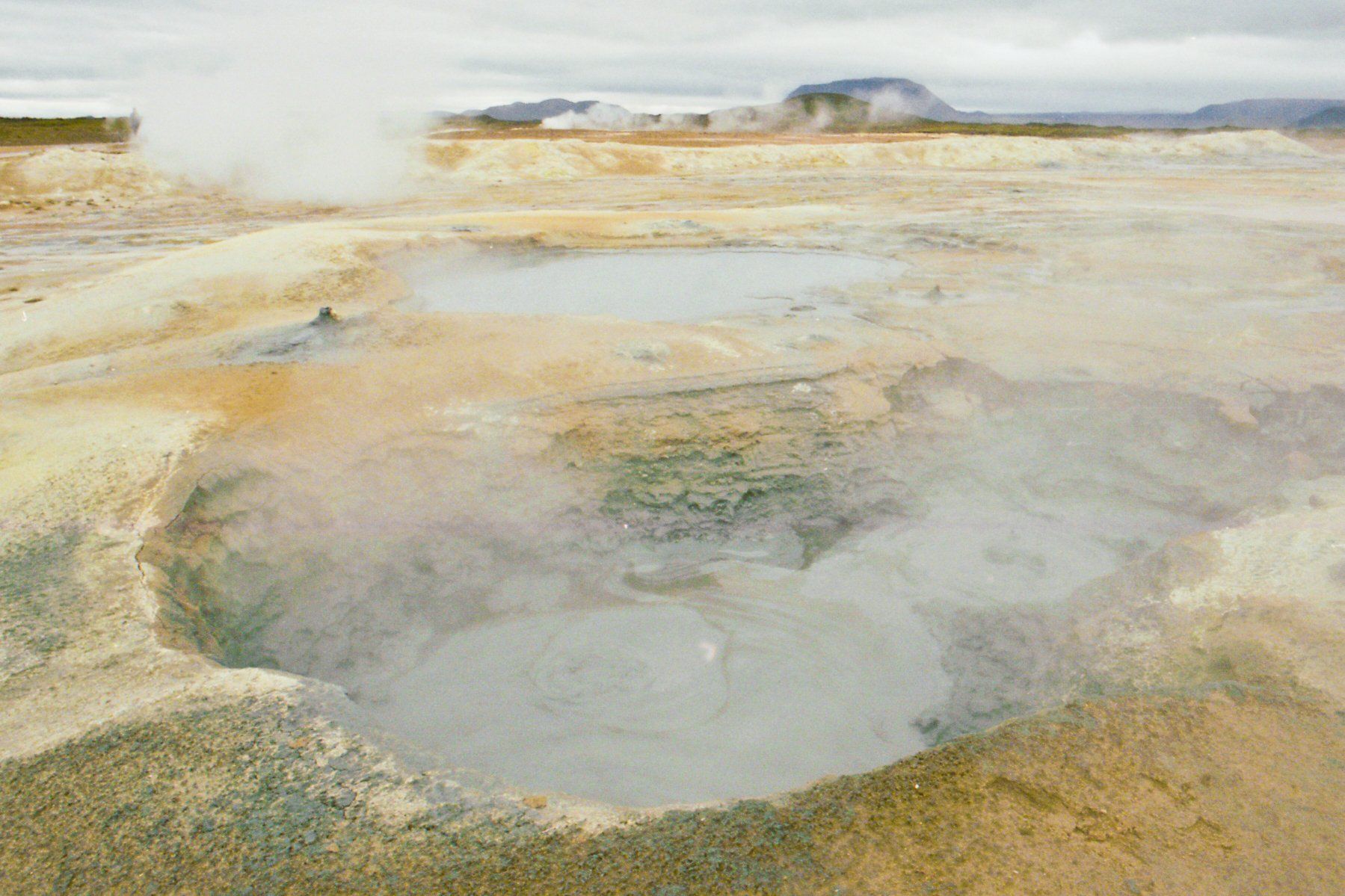
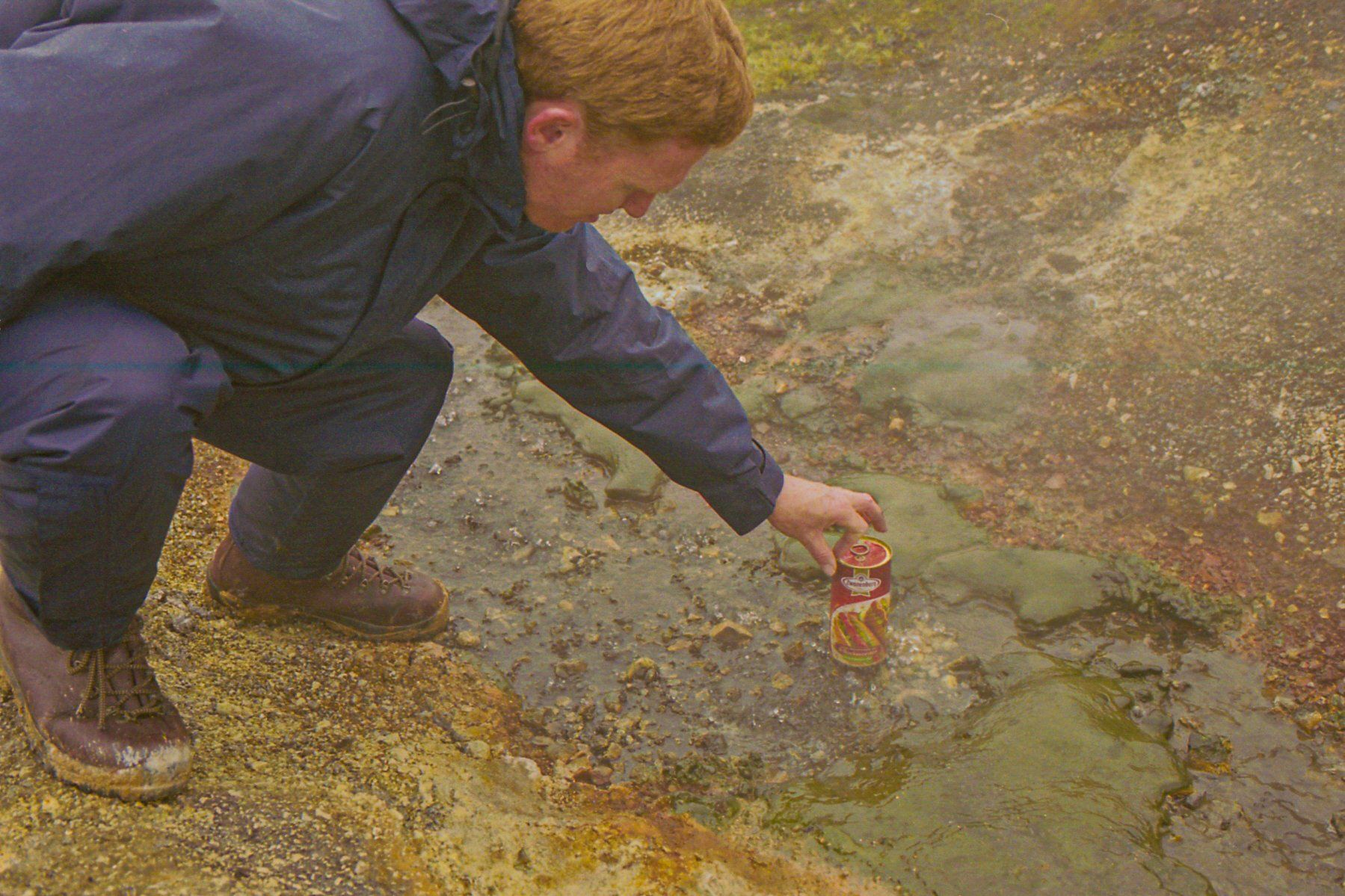
We stay in Akureyri for a few days and do some shopping. The weather is good, and even the Icelanders recognize this as summer. The local parking attendant—yes, a real city complete with parking meters—does his rounds in shorts. The hardest part of the journey is behind us. We now want to travel back along the ring road on the eastern side, with various detours into the interior. Via the mosquito lake Myvatn, which more than lives up to its name, we arrive at Krafla, where energy is extracted from geothermal heat amidst impressive roaring and massive plumes of steam. This is also the place where you can walk across the thin earth's crust between the bubbling, sulfur-smelling pools. This is a place frequented by many tourists; the bus route passes by here.
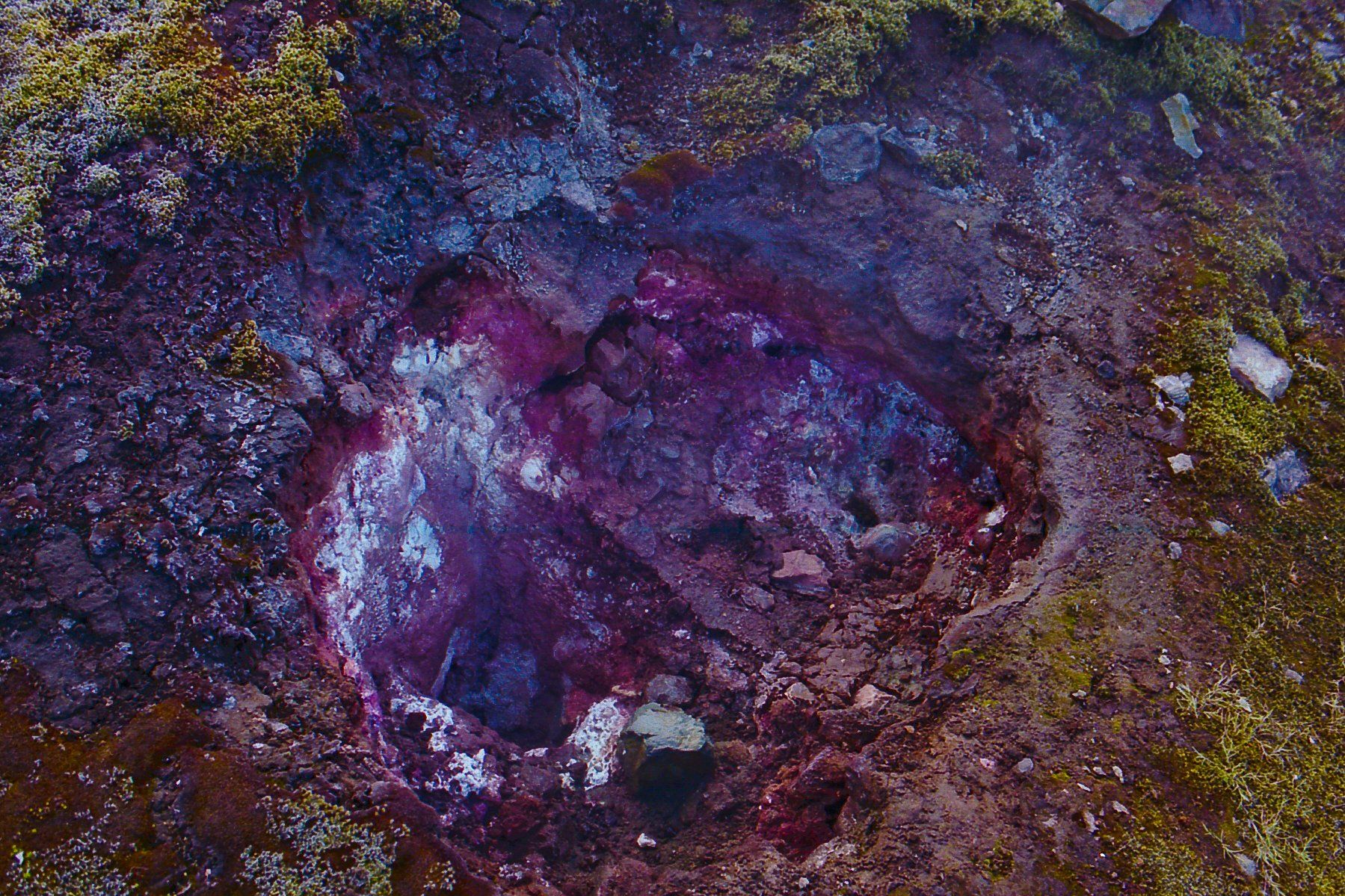
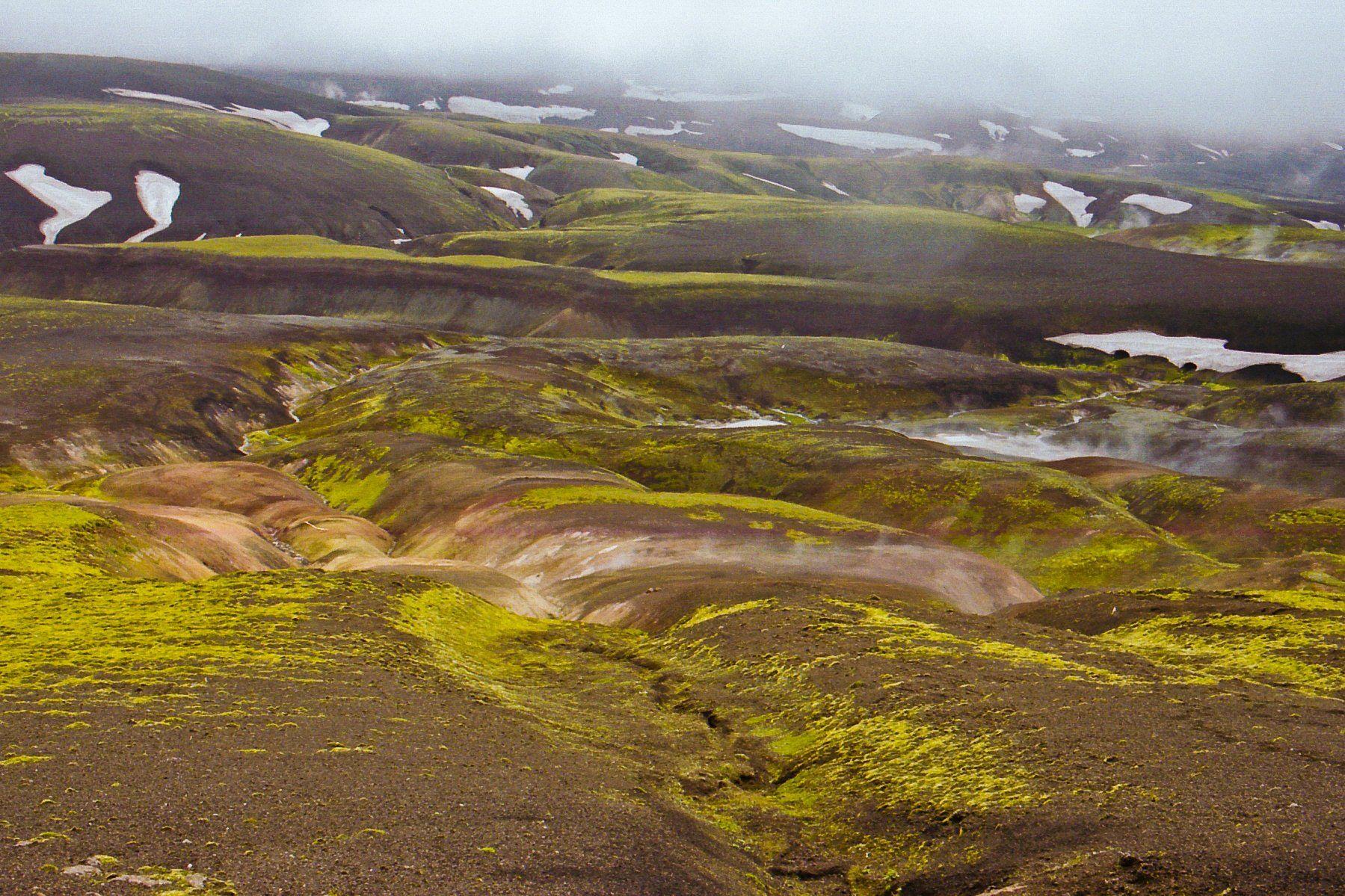
Further along the F863, you can take a circular walk at Leirnjúkur, which is also visited by tourists, but those arriving on their own, like us, or with special Iceland tours. Highly recommended: many colors of rock, steam rising from the ground everywhere, and magnificent panoramas. The differences between recent lava eruptions and those of the past are also clearly visible. A paradise for geologists.
We are faced with a dilemma: do we go to Askja and back, or continue via Askja? The choice is made because of the warning that there are no petrol stations for the next 268 km. A round trip would be just about right, and on the way there, we wouldn't know where the next station is. We are counting on finding information at Askja about where the next stop will be. So, off to Askja. Askja is an attraction many people want to visit, but you wouldn't notice that from the route. Sometimes it seems as if we really are the only ones taking this road. Narrow and deserted, crossing several small rivers, and a grim sight. Once we have completed the greater part of the journey, we spend the night at the Herðubreið. There, it turns out we are not the only ones after all, as the hut is fully booked and several tents are also braving the strong wind at the campsite. As we move on the next day, we encounter various tour buses squeezing through the narrow road at breakneck speed and overtaking us. The other traffic also makes its presence known, and upon arriving at Dekragil, the last hut before Askja, it is bustling with activity. Italians, French, Dutch, Germans—a motley mix of nationalities. But what do you call busy? When you encounter two cars a day and then suddenly twenty—yes, that is busy… From the parking lot at Askja, it is still quite a walk to the crater across a large, jet-black expanse. Well worth the effort.
F910
After that visit, we decide not to take the same way back, but to go via the F910 to Brú, where there is supposed to be a gas station. A good conversation with the Warden of Dekragil taught us that we wouldn't find a station there, but a little further on in Aðalból. He also shared some tips for wading: “Go with the flow” and “take it easy.” He is not a fan of the “bow wave,” so keep driving calmly and don't shift gears. Indeed, that makes a big difference. The F910 is a long, easily drivable road, by Icelandic standards. Little traffic and no tour buses. Although barren and vast, the landscape changes constantly. Upon arriving at Brú, we are overcome by the same feeling as earlier at Akureyri; we return to a green world with meadows and abundant life. We decide not to refuel, but to drive on to Egilsstaðir with the fuel from the jerrycans. There we will do our shopping and spend the night comfortably in a school converted into a guesthouse.
Although a small town by our standards, this is truly a place with a regional function. A large supermarket selling all kinds of things, a gas station, and various other shops. It is bustling with activity, and after such a long time with peace and quiet around you, it is actually quite pleasant.
The final stage
We have already been on the road for two weeks, so we have the biggest part behind us. The future looks a bit less adventurous, but, as it will turn out later, we were mistaken about that. We are now entering the “forest area” of Iceland. We learn that it is not the climate that causes little or no forest, but the sheep roaming free everywhere. In this region, it is forbidden to let sheep roam free, and there is a genuine forestry plan. We go in search of the oldest tree in Iceland, and at Hallormsstaðir we find the clue; signage points the way, and after a short walk, we end up at a sturdy pine. Complete with a sign displaying the planting date: 1938!
We move on and decide to take the shortcut via the F939. "Take" is a bit of an exaggeration. In good weather, this is drivable with any normal car, but there are a number of dangerous spots. The view is truly magnificent. Through the valley with green mountain slopes and babbling streams, mountain peaks rising above the clouds, and vistas you won't soon forget. Highly recommended yet again! The road leads us back to the ring road at the Djúpivogur fjord. The weather is beautiful, and we enjoy the lovely sunshine stretched out in the moss. Djúpivogur is another one of those villages where there is little to do. What stands out every time, however, is the varied architecture of the houses: brightly colored roofs, turrets, pastel shades, and buildings built haphazardly, interspersed with sleek new constructions—all mixed together. The ring road here is easily navigable, but also dangerous; the road is narrow, sometimes unpaved, and large dust clouds with backlight obscure your view of the cars in front and oncoming traffic. Just before Höfn, there is another steep slope to tackle: 17%! Going downhill is particularly tricky; the loose rock does not provide a safe braking distance. One of the highlights, and certainly highly recommended, is the glacier lake Jökulsárlon. Large chunks of the melting glacier flow into the ocean here via a glacier lake. It is possible to take a boat trip in a special amphibious vehicle, navigating between the ice floes. We ourselves were deeply impressed by the silence, vastness, and sheer volume of this breaking ice, and sat quietly on the shore, contemplating and admiring this spectacle.
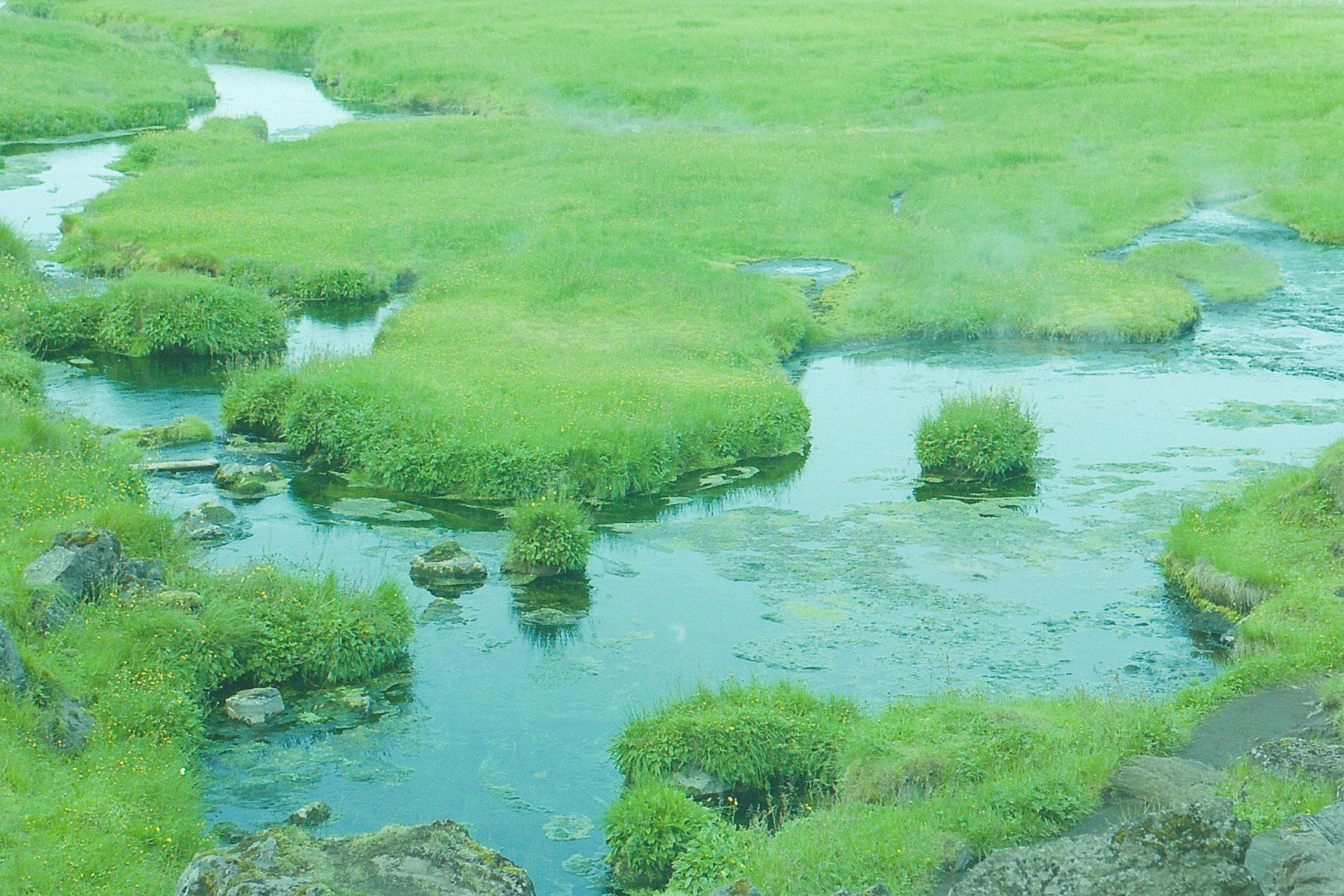
We continued along the ring road; although paved and modern, driving here is a unique experience too. You don't feel the need to drive fast, as you do back home in the Netherlands; there is a sense of calm about it. You stop more readily for a beautiful view or to take photos. We hadn't seen a waterfall in a while, so we paused briefly at Skogafoss. Now that we are getting closer to Reykjavik, there are more tourists, and this waterfall is very easy to reach. No less spectacular for that! If you are willing to get wet, you can get very close. The journey continues and the traffic gets busier; the stopping places have their own atmosphere that feels a bit like American movies. Simple cafes with a gas pump, car wash facilities, postcards, and tourists. Due to the bad weather, we didn't feel like driving on to Reykjavik to stay there for two days, so we stayed an extra day in Hveragerði. We opted for comfort and spent the night in a guesthouse. Hveragerði offers a lot of options by Icelandic standards: a library with internet access, a botanical garden, various dining options, and what we chose, a beautiful hike among the hot springs. In a forgotten corner, a Geysir stands erupting, not as large as the Strokkur, but impressive nonetheless due to its solitude. The hike we took leads along winding paths with streams here and there, some of which have warnings that you can burn your hands on the hot water. A nice touch was the spot where ice-cold water meets hot water. A small dike has been built, creating a pool behind it that was exactly the temperature of a pleasant bathwater. Due to the bad weather, we didn't test the pool further, but we can imagine that in better weather, this could be a delightful break during the hike.
Parting
The last day in Reykjavik. We arranged to return the car on Saturday instead of the working day, Friday. The porter at the harbor area was very friendly and even offered to call a taxi to take us to the city center. No formalities, no customs, just hand the keys to the porter and leave the car behind—a strange feeling. Without a car like this, you do feel a bit lost. That quickly passes as we walk through the city, where there is plenty to see. It is a charming little town in its own way that is difficult to describe; you have to experience it for yourself. The plane departs at seven in the morning; that seems like a reasonable time, but it essentially means we have to get up at three. Are there buses then? Yes, that is typical Iceland: if there is a need, there is one. A direct connection to Keflavik has been arranged; you can even pay by credit card on the bus, so saving up money for the final paid activity is not necessary. At the airport, however, it is all very disappointing. All flights depart one after the other and the small departure hall is packed, followed by the currency exchange offices, and as if it were a preview for home, long queues everywhere.
Back home
The final item on the agenda, having already been home for a week, is picking up the car in Rotterdam. That caused a bit of a problem at customs. Somewhere along the line, someone transferred my license plate incorrectly: 05 became OS, and that wasn't on my papers, so the car couldn't be mine! After the obnoxious officer handed it over to a somewhat milder lady, and after more than an hour—and after all my attempts at identification, talking my way out of it, and explaining the situation thoroughly—the car could finally be taken away. Just like in Iceland, the check at Eimskip in Rotterdam was smooth; although it was a break, the official interrupted his lunch to give the car a quick glance and wish me a safe journey home.
A beautiful end to an unforgettable journey.
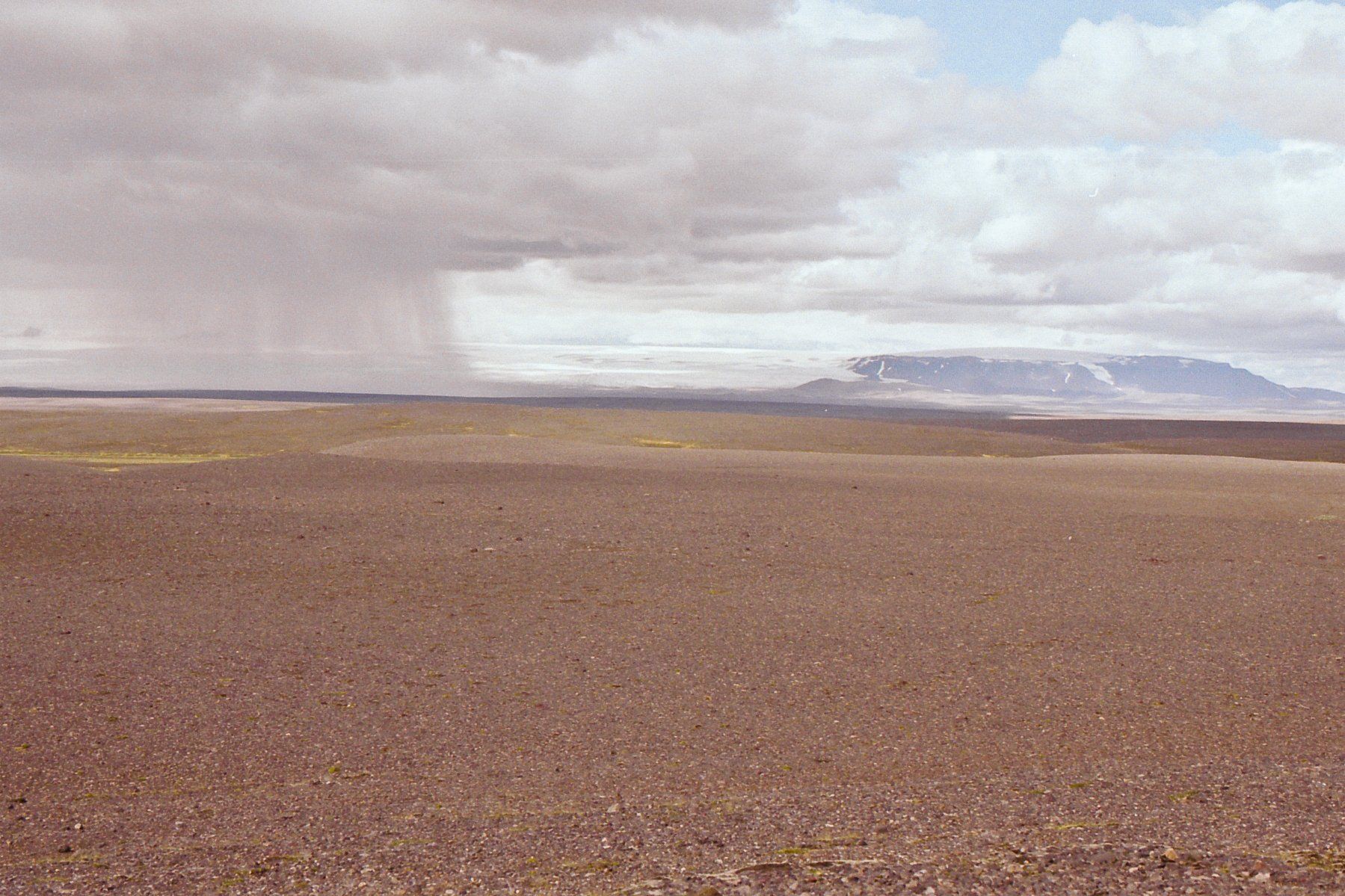
Iceland adventure
The travel party
Luis, Jan, Cees, Evert